Monday, 23 March 2020

ReadTheory - the right way


ReadTheory is a website that presents short texts to students accompanied by multiple choice questions. If the student fails, the system presents an easier text. If the student succeeds, the system presents more difficult texts. Logging in means you can store and track your progress. So far, so good. But ReadTheory really comes into its own as a tool for teachers to monitor students' progress and attainment.

I got into ReadTheory about 3 years ago and sadly, I made mistakes and missed opportunities to really get the most from the system. I was such a fool, doing it the wrong way. Here's how to do it the right way!

Step 1: Create your own account

Go to https://readtheory.org/app/sign-up/role and click "Teacher"

Then, if your institution uses Google, select "Sign in with Google". Otherwise, create a username and password.

Step 2: Create a classroom

Don't skip this stage! Create a class and make sure you check or uncheck the box beside "Some students in this class are under 13". You don't need to determine the grade at this point, but I think it's nice to fill in the name of your school.

Step 3: Add students

There are 2 ways to do this and I strongly recommend the "Send code" method if you have more than 5 or 6 students.

Step 4: Show the students how to create an account and join your class

If your school uses Google, get them to use their school Google accounts. It's very important that the students enter a valid email adress so they can reset their password later on. Also, make sure they choose a username that is recognisable and that they enter the correct class code.

Step 5: Set goals and deadlines for your students

Explain to the students that they'll need 15 minutes at a time to complete tests. When they complete a test, they earn "knowledge points". Set goals for your students such as, "Aim to earn 50 knowledge points today".

Step 6: Monitor your students using the "Progress Reports" tool. 
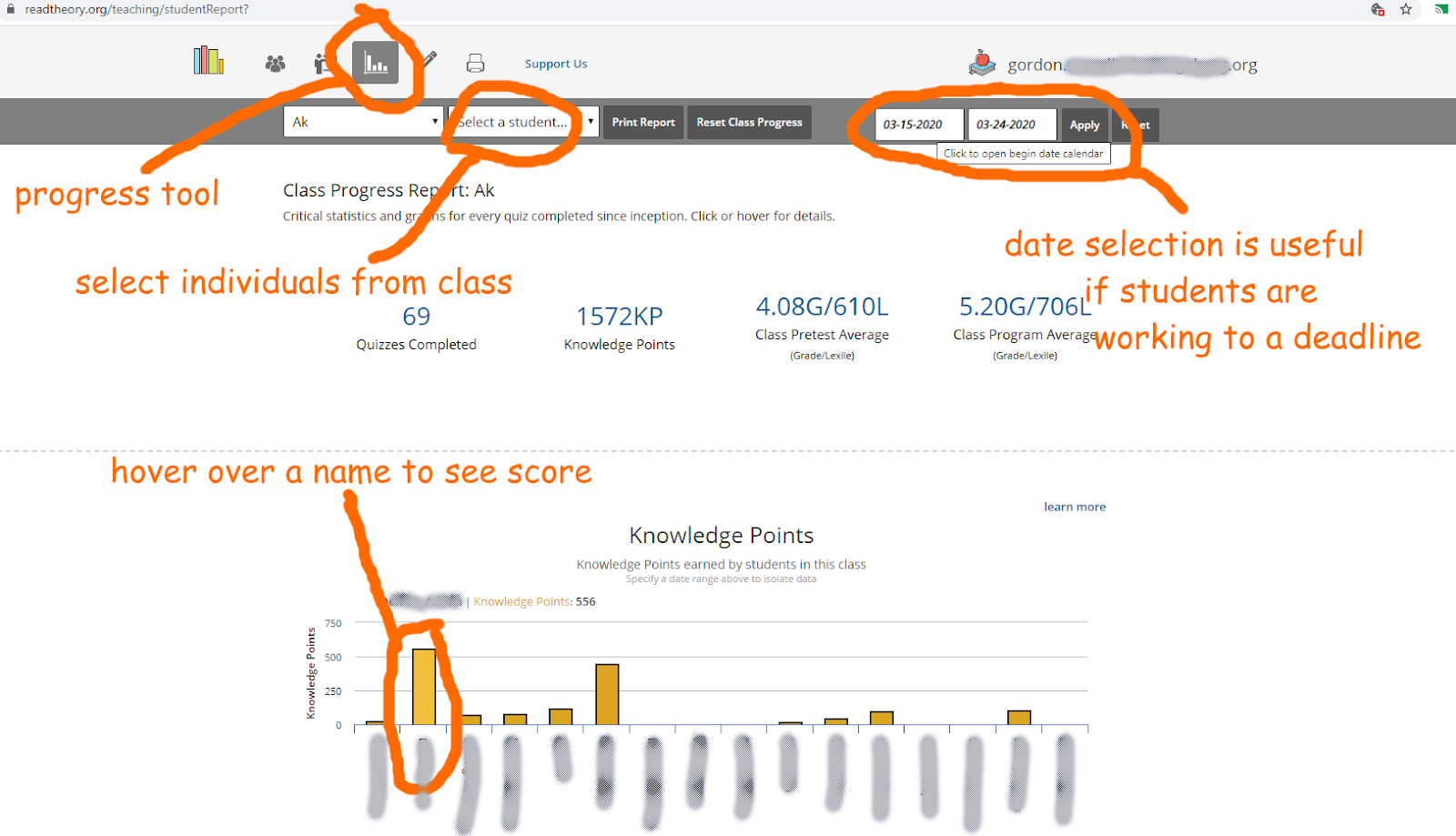

Using ReadTheory in Sweden

ReadTheory is aimed at students in the USA and the progress reports describe students' progress in relation to what they'd be expected to be reading at any given year in school (grade). The reports also descibe the Lexile level of the material the students have been working with.

Nobody seems to have done this before, so after hours of research, here's a rough comparison between ReadTheory progress report levels, CEFR and the common English language attainment levels in Swedish schools:

Grade
(U.S.A.)
Age
Lexile band
CEFR
Swedish
schools

0
3-6
0L-425L
A1

1
6–7
A2
Åk 6
2
7–8
450L-725L
3
8–9

4
9–10
645L-845L
Åk 9
5
10-11
B1
6
11–12
860L-1010L
Eng 5
7
12–13
8
13–14
B2
Eng 6
9
14–15
960L-1115L
10
15–16
11
16–17
1070L-1220L
Eng 7


Final thoughts

ReadTheory gets pretty boring after a while, so encourage students to work at it in short bursts rather than for hours on end. Give them goals and deadlines and create a bit of competition to make it more fun. Encourage your students because the effort they put in definitely pays off in terms of improved reading comprehension, vocabulary and production.


Wednesday, 18 March 2020

Video + Quiz = Nice


Before I die, I should get round to tasting a Subway sandwich. Problem is, I'm too shy, self-conscious and indecisive. If they had a sort of Soviet Russian version with just one type of sandwich, I'd probably go there.

Anyway, for some reason, mysterious algorithms directed me towards watching this video about Subway. As a loyal servant of our machine overlords, I obeyed.

It turns out that Business Insider's YouTube channel is a goldmine, especially if like me, you're interested in what makes businesses tick.

Liking the video a lot, I decided to get my students to watch it and designed a quiz in Google Forms to test their understanding and stimulate interest in what it takes to be successful in the fast food business. Here's a link to the quiz: https://forms.gle/L8dVgEFaM8diJFzA8

Embarrassingly, the quiz contained many errors which my very gifted and attentive students pointed out. So if you like this quiz, you really have my students to thank.

This link lets you make a copy which you can adapt and publish: Quiz: The rise and fall of Subway but you'll need to send an access request as there's no safe way to share a form for copying whilst preventing everyone with the link being able to edit the original.

Google Forms is a fantastic tool when you want to check if students have read a text or watched a video and really understood it. A well designed quiz lets you check if everyone understands core concepts and language before launching into more ambitious group work on a subject.

Here's a guide that helped me get started: Create & grade quizzes with Google Forms

Finally, my students give Subway an average score of 3.35 out of 5 which is pretty positive. I must ask them about other fast food outlets...


Narishkin, Abby. 28 July 2019. "The Rise and Fall of Subway". Business Insider. Retrieved from: https://youtu.be/duQow41bTx0

Monday, 9 April 2018

Timothy Snyder's road to unfreedom

Over the coming weeks, we're studying contemporary history - looking at what's happened to Russia and also to western countries since the collapse of the Soviet Union in 1990.

We're working from this article by Timothy Snyder: "Vladimir Putin’s politics of eternity" but I'm breaking it down into smaller parts to make it easier to identify the key ideas and see how well they can be applied to our domestic politics.

Christiane Amanpour conducted a good interview with Snyder, in which he outlined the major themes of the article and latest book, "The Road to Unfreedom". It's a great starting point for exploring this topic and you can watch it here:


Wednesday, 21 March 2018

Exploring the deep questions posed in pop songs

Lots of songs contain questions that are fun and interesting to reflect upon and discuss.

Lately, we've been ransacking our memories, playlists and search engines to find good questions. When students find questions, they write them up in a shared document: Important questions posed by songs

Each student then prepares a short talk (2-5 minutes) based on their question. So far, students have taken different approaches to this, e.g. scientific, philosophical, personal and imaginative. Then we pass the question around the class to get everyone's thoughts.

It's a simple exercise that leads to some surprising insights, memories, good stories, creative thinking and which also points us forward towards new avenues of exploration in the future.


Tuesday, 20 March 2018

Interesting conference about sustainable development - Tuesday 24th April

Both in English classes and Global profil we've been learning about the UN sustainable development goals - Agenda 2030. In our "Better tomorrow" project, we presented ideas on how to realise these ambitious goals.

Now, Stockholm Environment Institute (SEI) are organising an exciting conference on this theme.

It'll take place in Stockholm at Meeting Room, Alströmergatan 20, 112 47 Kungsholmen

SEI have planned a full program with over 16 speakers from 4 continents. Read more here: https://www.eventbrite.co.uk/e/sei-science-forum-2018-innovating-for-a-sustainable-future-tickets-43834457041

A few of us have already got our tickets - it'd be great if you could join us!

Thursday, 8 February 2018

Canine tales

We're looking at the canine community of Chernobyl, inspired by this video:


We've also read this article in the Guardian:

Julie McDowal, "Meet the dogs of Chernobyl – the abandoned pets that formed their own canine community" The Guardian Monday 5th February 2018

We have a worksheet too.

Then we're writing stories about dogs to both tell to the class and post on the wall. The first step is to add or claim a dog in this presentation: Canine stories

You can then write a dog story by hand or on a computer and share it with your teacher.