Wednesday, 10 February 2021

Grammar with Khan Academy


Khan Academy has a grammar course and not only is it free, it's really good!

Just like with ReadTheory, you can create a class and monitor your students' progress. Khan Academy works really well with Google Classroom, letting you import whole classes, allowing the students to log in using their school Google accounts. If a student already has a Khan Academy account, they can enter a class code to join your class.

Unfortunately, it's not suitable for absolute beginners, but seems to work with learners at A2 level and upwards. It provides a challenge even for the most advanced users of English.

The quizzes are short so students get feedback on their attainment and progress really quickly. It's perfect for those with short attention spans.

A difference between Khan Academy Grammar and ReadTheory is that progress is not related to any particular level of English. So as a teacher, one might consider looking at all the grammar exercises and then setting some goals for say, students aiming for "Engelska 5". Then again, the students I encounter have very different strengths and weaknesses in English grammar. So far, it's been interesting to watch them explore and discover those areas where they need to practice.

I would really like to have one system for my students to work independently on their reading and listening comprension, pronunciation, vocabulary and grammar. Technically it must be possible but nobody seems to have created it as of yet. So for now, we're using a combination of ReadTheory and Khan Academy Grammar and regular lessons and assignments in Google Meet and Classroom.

Monday, 14 December 2020

3 new Google Forms quizzes

It's Monday so time for a self-marking quiz. This type of quiz is a really nice way to let students work on their own and see for themselves if they've understood a piece of material, such as a text or film. 

Quizzes always take longer than you think to construct. It's easy to think of the correct answers; it's the incorrect answers that take me ages to think of. So they require extra preparation, but then you can relax and enjoy not having to mark anything.

A good thing about quizzes is that you can mix in different types of questions. As well as your normal comprehension or knowledge questions, I've starting throwing in some opinion questions. These opinions then form the basis of very fruitful class discussions. When sitting at home, doing a quiz on a particular topic, I think students start to think more deeply about that topic, and are more inclined to express an opinion than if I just asked the same question in class. Then, when the class meets together and I show a summary of the aggregated results (which are naturally anonymous), it's fun to see previously quiet students speaking out to defend their views.  

The default settings in Google Forms are good, make sure you collect email addresses - otherwise you won't know who answered. Also, encourage your students to try several times and give them a target score. If you want students to upload files in a quiz, make sure the quiz is located on your own Google Drive and NOT a shared drive (learnt that today!).


Here are some quizzes we've been working with:

Car-T Cells

How McDonald's really makes money

The artists keeping Kenya’s slums safe

Feel free to copy and get in touch if you'd like an editable copy that you can put in your own Google Drive system.


Thursday, 9 April 2020

Covid-19 quiz exposes misconceptions

Loch Ness monsters return to Scotland

Almost anything we do about covid-19 is going to have a short expiry date. Nevertheless, I'm posting this exercise as it's from one of my favourite YouTube channels, ColdFusion. It's one of the new wave of semi-professional science & technology channels that offer fresh, well-researched and entertaining short videos that are perfect for use in English classes.

Dagogo Altraide is the person behind ColdFusion and his videos are not always perfect. But in a classroom situation, that can be an advantage as we want students to approach media critically. It's not so easy to be critical of well-funded, slick and professional films. Dagogo himself usually ends videos by asking, "What do you think?" and it's this kind of curiosity and openness that makes him a good role model. Furthermore, Dagogo's optimism is infectious.

Here's the video:


Altraide,  Dagogo [ColdFusion]. 29 March 2020. "COVID-19: We’re Fighting a War, But There’s Hope". Retrieved from: https://youtu.be/RFnSmcfKWQo

Here's the quiz: https://forms.gle/Fh3VCjRWpiVbzsTH8
I was a bit surprised to discover how many misconceptions people have about the new coronavirus. So the quiz is worth taking.

Here's a link that allows you to make a copy of the quiz (but you'll need to send an access request):
Quiz - Covid-19: We're fighting a war but there's hope


Thursday, 2 April 2020

Multiplayer fun & learning with skribbl.io

To cheer ourselves up, a group of around 15 of us tried out skribbl.io for the first time today. It's a fun way to get together and can also be used to help students learn specific words and phrases.

You can drop into skribbl,io and play a game with random strangers just to get a feel for how it works. Each player gets a chance to choose a word from a selection of 3 words. Then, the clock starts ticking and that player has 80 seconds to draw a picture. During those 80 seconds, everyone tries to guess the word (or phrase) with just the drawing and a hangman style set of dashes to indicate how many letters are needed. Players can try as many times as they like but earn more points for guessing quickly.

As a teacher, you can create a private game, add in target language that will appear in the game and send the link to your students. When planning your game, remember that a round consists of 80 seconds for each player. So if you have 10 players, a round will take 13-14 minutes. You can adjust the length of time and how many rounds you wish to play.

Here are step by step instructions:

1) Write your name and (if you like) adjust your avatar's appearance.

2) Set the language. Note that if you just want to play a random game, English is best.

3) Create your private room for you and your students.

4) A round with 10 students will take 13-14 minutes (if draw time is 80 seconds per student). Adjust the number of rounds and draw time to suit you and your group.

5) If you have a set of words/phrases you want to include, enter them here, separated by commas. Your target words will be mixed with the game's own words unless you choose "Use custom words exclusively". Remember that each player will get a turn per round, so if you have 2 rounds with 15 students, you'll need 30 words to avoid repetition.

6) Copy the link and share it with students. As they sign up (by clicking "play"), they'll appear under "Players".

7) When everyone's assembled, click "Start game" and enjoy! 


Monday, 23 March 2020

ReadTheory - the right way


ReadTheory is a website that presents short texts to students accompanied by multiple choice questions. If the student fails, the system presents an easier text. If the student succeeds, the system presents more difficult texts. Logging in means you can store and track your progress. So far, so good. But ReadTheory really comes into its own as a tool for teachers to monitor students' progress and attainment.

I got into ReadTheory about 3 years ago and sadly, I made mistakes and missed opportunities to really get the most from the system. I was such a fool, doing it the wrong way. Here's how to do it the right way!

Step 1: Create your own account

Go to https://readtheory.org/app/sign-up/role and click "Teacher"

Then, if your institution uses Google, select "Sign in with Google". Otherwise, create a username and password.

Step 2: Create a classroom

Don't skip this stage! Create a class and make sure you check or uncheck the box beside "Some students in this class are under 13". You don't need to determine the grade at this point, but I think it's nice to fill in the name of your school.

Step 3: Add students

There are 2 ways to do this and I strongly recommend the "Send code" method if you have more than 5 or 6 students.

Step 4: Show the students how to create an account and join your class

If your school uses Google, get them to use their school Google accounts. It's very important that the students enter a valid email adress so they can reset their password later on. Also, make sure they choose a username that is recognisable and that they enter the correct class code.

Step 5: Set goals and deadlines for your students

Explain to the students that they'll need 15 minutes at a time to complete tests. When they complete a test, they earn "knowledge points". Set goals for your students such as, "Aim to earn 50 knowledge points today".

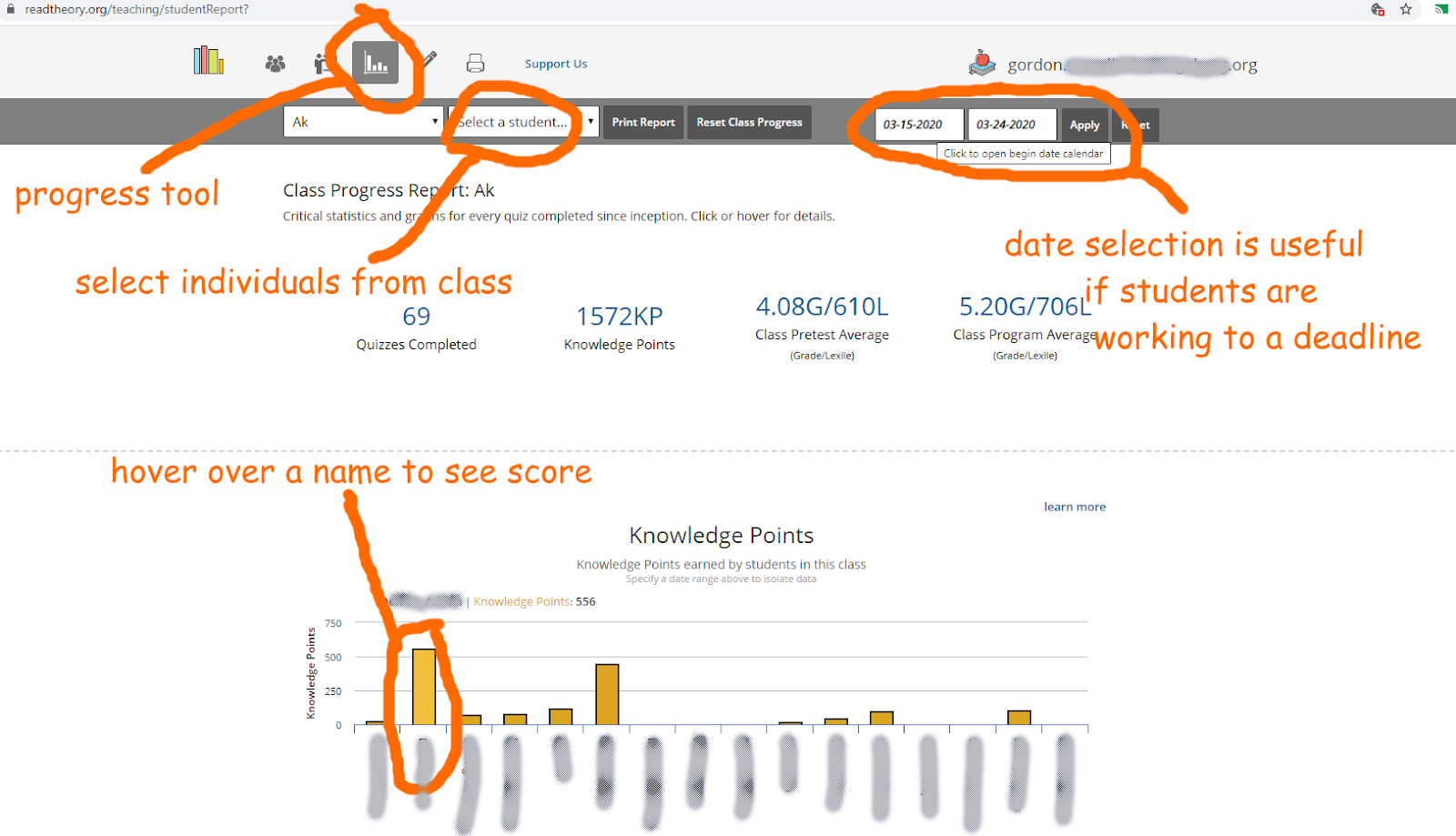
Step 6: Monitor your students using the "Progress Reports" tool. 


Using ReadTheory in Sweden

ReadTheory is aimed at students in the USA and the progress reports describe students' progress in relation to what they'd be expected to be reading at any given year in school (grade). The reports also descibe the Lexile level of the material the students have been working with.

Nobody seems to have done this before, so after hours of research, here's a rough comparison between ReadTheory progress report levels, CEFR and the common English language attainment levels in Swedish schools:

Grade
(U.S.A.)
Age
Lexile band
CEFR
Swedish
schools

0
3-6
0L-425L
A1

1
6–7
A2
Åk 6
2
7–8
450L-725L
3
8–9

4
9–10
645L-845L
Åk 9
5
10-11
B1
6
11–12
860L-1010L
Eng 5
7
12–13
8
13–14
B2
Eng 6
9
14–15
960L-1115L
10
15–16
11
16–17
1070L-1220L
Eng 7


Final thoughts

ReadTheory gets pretty boring after a while, so encourage students to work at it in short bursts rather than for hours on end. Give them goals and deadlines and create a bit of competition to make it more fun. Encourage your students because the effort they put in definitely pays off in terms of improved reading comprehension, vocabulary and production.


Wednesday, 18 March 2020

Video + Quiz = Nice


Before I die, I should get round to tasting a Subway sandwich. Problem is, I'm too shy, self-conscious and indecisive. If they had a sort of Soviet Russian version with just one type of sandwich, I'd probably go there.

Anyway, for some reason, mysterious algorithms directed me towards watching this video about Subway. As a loyal servant of our machine overlords, I obeyed.

It turns out that Business Insider's YouTube channel is a goldmine, especially if like me, you're interested in what makes businesses tick.

Liking the video a lot, I decided to get my students to watch it and designed a quiz in Google Forms to test their understanding and stimulate interest in what it takes to be successful in the fast food business. Here's a link to the quiz: https://forms.gle/L8dVgEFaM8diJFzA8

Embarrassingly, the quiz contained many errors which my very gifted and attentive students pointed out. So if you like this quiz, you really have my students to thank.

This link lets you make a copy which you can adapt and publish: Quiz: The rise and fall of Subway but you'll need to send an access request as there's no safe way to share a form for copying whilst preventing everyone with the link being able to edit the original.

Google Forms is a fantastic tool when you want to check if students have read a text or watched a video and really understood it. A well designed quiz lets you check if everyone understands core concepts and language before launching into more ambitious group work on a subject.

Here's a guide that helped me get started: Create & grade quizzes with Google Forms

Finally, my students give Subway an average score of 3.35 out of 5 which is pretty positive. I must ask them about other fast food outlets...


Narishkin, Abby. 28 July 2019. "The Rise and Fall of Subway". Business Insider. Retrieved from: https://youtu.be/duQow41bTx0

Monday, 9 April 2018

Timothy Snyder's road to unfreedom

Over the coming weeks, we're studying contemporary history - looking at what's happened to Russia and also to western countries since the collapse of the Soviet Union in 1990.

We're working from this article by Timothy Snyder: "Vladimir Putin’s politics of eternity" but I'm breaking it down into smaller parts to make it easier to identify the key ideas and see how well they can be applied to our domestic politics.

Christiane Amanpour conducted a good interview with Snyder, in which he outlined the major themes of the article and latest book, "The Road to Unfreedom". It's a great starting point for exploring this topic and you can watch it here:


Wednesday, 21 March 2018

Exploring the deep questions posed in pop songs

Lots of songs contain questions that are fun and interesting to reflect upon and discuss.

Lately, we've been ransacking our memories, playlists and search engines to find good questions. When students find questions, they write them up in a shared document: Important questions posed by songs

Each student then prepares a short talk (2-5 minutes) based on their question. So far, students have taken different approaches to this, e.g. scientific, philosophical, personal and imaginative. Then we pass the question around the class to get everyone's thoughts.

It's a simple exercise that leads to some surprising insights, memories, good stories, creative thinking and which also points us forward towards new avenues of exploration in the future.


Tuesday, 20 March 2018

Interesting conference about sustainable development - Tuesday 24th April

Both in English classes and Global profil we've been learning about the UN sustainable development goals - Agenda 2030. In our "Better tomorrow" project, we presented ideas on how to realise these ambitious goals.

Now, Stockholm Environment Institute (SEI) are organising an exciting conference on this theme.

It'll take place in Stockholm at Meeting Room, Alströmergatan 20, 112 47 Kungsholmen

SEI have planned a full program with over 16 speakers from 4 continents. Read more here: https://www.eventbrite.co.uk/e/sei-science-forum-2018-innovating-for-a-sustainable-future-tickets-43834457041

A few of us have already got our tickets - it'd be great if you could join us!

Thursday, 8 February 2018

Canine tales

We're looking at the canine community of Chernobyl, inspired by this video:


We've also read this article in the Guardian:

Julie McDowal, "Meet the dogs of Chernobyl – the abandoned pets that formed their own canine community" The Guardian Monday 5th February 2018

We have a worksheet too.

Then we're writing stories about dogs to both tell to the class and post on the wall. The first step is to add or claim a dog in this presentation: Canine stories

You can then write a dog story by hand or on a computer and share it with your teacher.


Tuesday, 23 January 2018

A Better Tomorrow - 7th Feb 2018 10:30-11:45

Think of a specific situation in our world that could be improved with the help of technology and/or good policy decisions so that the next generation can have a better future.


Create a short talk (like the space expo talks) in which you describe the current situation and then describe the technology and/or policies that could mitigate this problem.


You could look at electricity generation, lung cancer, homelessness, education, employment, shopping, farming, household pets, batteries, death... whatever you feel passionate about. If you need inspiration, look at the 17 sustainable development goals of Agenda 2030. 


This should be a "Yellow and Green hat" talk: optimistic and creative in solving problems. But don't neglect the other "thinking hats" - include statistics, hard facts, emotions and risk awareness.


Share your presentation/manuscript from the outset so your teacher can see your progress. If doing group work, take extra care to work in one (1) Google document and share all that you do. Good communication with your classmates and teachers is essential for this to work.


Friday, 8 December 2017

Asymmetrical updating - Tues 16th January 2018, 16:30-18:00

Stockholm School of Economics (Handelshögskola)

Optimistic bias, brains and climate change

The human brain finds good news more credible than bad news, so that we are more willing to believe that we are healthier, smarter and more beautiful than we thought before.
Asymmetrical updating plays a large role in politics; it bears on people's beliefs about climate change, immigration, and political candidates. It also tells us a great deal about consumption patterns – and about how to influence people.

Come and listen to Cass R. Sunstein, a professor at Harvard Law School, who was an advisor to US President Barack Obama. He is one of the most-cited legal scholars worldwide, a prolific writer and the author, most recently, of: #Republic: divided democracy in the age of social media, Impeachment: A Citizen’s Guide and The economics of nudge.


Here's a short video featuring Cass Sunstein to give you an idea of what he's like:

Thursday, 9 November 2017

Self-assessment tool

Make your own copy of this document and share it with your teacher (me!!!):

CEFR checklist (sv)

While we have individual appraisal meetings, there's some crime work going on. Here's one of the reading exercises:

Shoplifter fake baby scam

Monday, 2 October 2017

Public speaking

Right now we're preparing to give "lightning talks" related to space.

Most students are nervous about public speaking, and here's a test to see what might be causing that:
https://hbr.org/2016/11/assessment-whats-feeding-your-fear-of-public-speaking

I'm encouraging the use of Edward de Bono's 6 Thinking Hats as a way to improve the quality and appeal of talks:


White hat: Give information - "The facts, just the facts."

Yellow hat: A bright and optimistic attitude, exploring the positives, demonstrating value and benefit.

Black Hat: Exercise judgement - spot the difficulties and dangers; where things might go wrong. Probably the most powerful and useful of the Hats but a problem if overused.

Red Hat: When using this hat you can express emotions and feelings and share fears, likes, dislikes, loves, and hates.

Green Hat: Focus on creativity; the possibilities, alternatives, and new ideas. It's an opportunity to express new concepts and new perceptions.

Blue Hat: Manage the thinking process and bring everything in your presentation together.

When it comes to creating slides, why not try the Takahashi method? Masayoshi Takahashi came up with this method as a way to reduce his own nervousness and help him focus when speaking in public. It's very simple: you can have as many slides as you like, but each one can only contain up to 2 words - preferably simple and short words.

The lightning talk requires great discipline. Every bit of the talk must pass the "so what?" test. Here's an example:

Sputnik 1 was launched in 1957.
So what?
It was the first human made object to be put into space.
So what?
It was the start of the "space age" in which countries raced to explore space,
the USA created NASA and scientists gained access to new ways to study the earth.
Ok...

So now you can create a single sentence, summing up that "so what" conversation:

In 1957, as Sputnik 1 circled the earth, the space age was born,
opening up new ways to learn about the universe and our own planet.


Sunday, 17 September 2017

Monday 2 October 16:00-18:00 - interesting lecture!


Back to Nature 

Lectures and discussion of Biomimicry
Karolinska Institute, Flemingsberg

A TED-inspired salon event, free admission for students & others organized by the Doctoral Programme for Development and Regeneration (DEVREG).

At this TED-inspired two-hours event, we gain a better understanding of how studying and mimicking nature as part of medical research could lead to important breakthroughs and innovations. The theme will be explored by listening to talks on the subject followed by an open-minded campfire session with the speakers and where you are welcome to share your thoughts and questions.

Snacks & refreshments will be served. To get one of the complimentary tickets and join this event, please register here before September 26:
https://www.eventbrite.com/e/back-to-nature-ki-devreg-salon-event-tickets-37906046004?aff=es2

A TED-inspired salon event, free admission for student & others

The core idea of biomimicry is that nature has already solved many of the problems we are grappling with. At this salon event you will learn what biomimicry is about and get some examples of how it is used in research and innovations.
At this TED-inspired two-hour event, we gain a better understanding of how studying and mimicking nature as part of medical research could lead to important breakthroughs and innovations. The theme will be explored by listening to talks on the subject followed by an open-minded campfire session with the speakers and where you are welcome to share your thoughts and questions.
Speakers
Johanna Painer, PhD, DVM, University of Veterinary Medicine, Vienna
Johanna is a researcher and wildlife veterinarian with special interest in Ultrasonography and Reproduction in Wildlife, Wildlife Anaesthesia and Wildlife Crime. She is also a consultant veterinarian for the Orsa Predator Park in Sweden. She is part of a team investigating how mammals rely upon scent for intraspecific communication. She will present parts of her research and share her thoughts about what and how we could learn from nature and wildlife.
Janne Johansson, Professor, Karolinska Institutet
Janne is head of a research group working on mechanisms of protein aggregation in disease, development of protein drugs, and protein assembly in spider silk formation. This broad approach has so far generated for example synthetic proteins for treatment of lung disease. Janne will talk about how they succeed in finding a method to make artificial spider silk and how it could be used in biomedical applications.
Monday 2 October 16:00-18:00
Hörsalen, Novum, plan 4, Blickagången 6, Karolinska Institute Campus Huddinge, Flemingsberg
15:10  Hagabergs folkhögskola Buss 753 mot Östertälje station
15:23  Östertälje Pendeltåg 36 mot Märsta
15:40  Flemingsberg Gå 339 meter 15:48  Blickagången 6, Huddinge


Thursday, 14 September 2017

Problem solving 2

This week, we're continuing to learn more about problem solving - this time with the help of business journalist and author, Anne Kreamer. Here's the handout and questions:

Creativity Lessons from Charles Dickens and Steve Jobs

In one of the classes, we tested our ability to discern whether a person was a member of the Democrat or Republican party. It's not easy - try it here: AI can tell Republicans from Democrats – but can you? Take our quiz

But getting back to the whole problem solving and creativity thing, Anne Kreamer mentions the Remote Associates Test (RAT) If you fancy giving your brain a workout, try this: A collection of tasks from the Remote Associates Test of Creativity

We also looked at this interesting short video where Kreamer gives good, practical advice about how to handle a person crying at work:


And finally, here's the entertaining clip that that my colleague Anne G. shared to help you translate Swedish swear words to English:
http://www.bbc.co.uk/programmes/p05d0gpt


Wednesday, 6 September 2017

2 interesting events in English

Develop your English language and scientific and technical knowledge by coming along to these 2 mind expanding events in the coming weeks...

1) Climate change lecture

As I write, there are just 14 places left for what promises to be a very interesting lecture and scientific discussion about climate change and how to reduce carbon emissions in the future.

It's on Thursday 21st September in Stockholm University and starts at 13:30. That means setting off from Hagaberg at 12:10. The event goes on till 17:00 but obviously you don't have to stay that long.

If you're interested, read the full program and register a.s.a.p. here:


See Kevin Anderson, the keynote speaker here:


2) Google Cloud Summit

This is a whole day event in central Stockholm which Marcus Nyberg and I are attending on Tuesday 3rd October.

It's going to be pretty technical, but could be of interest to any of you who are considering a future career in IT. Things are changing fast and taking part in the Google Cloud Summit will put you at the frontier of digital developments. Check out the program and register here: Google Cloud Summit - Stockholm 2017

Obviously for both events, you need to get approval from your teachers so as not to be reported absent from lessons. SL cards are available and we can talk about compensation for long hours...


Thursday, 31 August 2017

Problem solving 1

Welcome to the new academic year!

I have 4 English groups in Hagabergs folkhögskola and we're using this Google Classroom:
English for B1-B2 users 2017-8 (@hagaberg.org account required)

Hopefully there'll be lots of problems and mistakes that lead to learning which for us equals success.

Many factors prevent us from solving problems and perhaps the biggest is that we fail to actually see what the problem really is - hence the Einstein quote.

Instead of rushing to offer solutions, our first English exercise is to describe some problems and then look at them to see if we can redefine them or get to the root of them.

We are collecting problems to work on: Problems. There's an assignment linked to it in our Google classroom: Redefining and solving problems where everyone chooses someone else's problem and tries to redefine it and offer possible solutions.

A reading exercise is included in this topic based on an article by Sabina Nawaz in Harvard Business Review: The Problem with Saying “Don’t Bring Me Problems, Bring Me Solutions”

Wednesday, 19 April 2017

Psychological testing week

Inspired by a student presentation last month on introvert and extrovert personality types, this week we're trying out some psychological tests.

Online tests in English are a language challenge and introduce new vocabulary and concepts.

It will be interesting to see if our personalities change when using a second language.

We need to evaluate the tests themselves - do they reveal anything about ourselves? Is there any scientific basis to them?

Finally, there are issues around privacy - some tests want your email address. We will use services like nada or TempMail to avoid giving away personal information to third parties.

Here are some tests to try out:

Jung Typology Test based on Carl Jung’s and Isabel Briggs Myers’ personality type theory.

IPIP Big-Five Factor Markers based on the best accepted and most commonly used model of personality in academic psychology.

Open Extended Jungian Type Scales 1.2 - a highly accurate alternative to the Myers-Briggs Type Indicator.

When you've done a test, learn more about the different types of personality being described by these indicators:

16Personalities.com - personality types - an accessible way to learn about the different 4 letter combinations you get from a Briggs Myers test.

The Five Factor Model - the easiest introduction to the IPIP big 5 markers I could find.